صحافة الكترونية مرخصة وزارة الاعلام ترخيص رقم 366-2019

صحافة الكترونية مرخصة وزارة الاعلام ترخيص رقم 366-2019
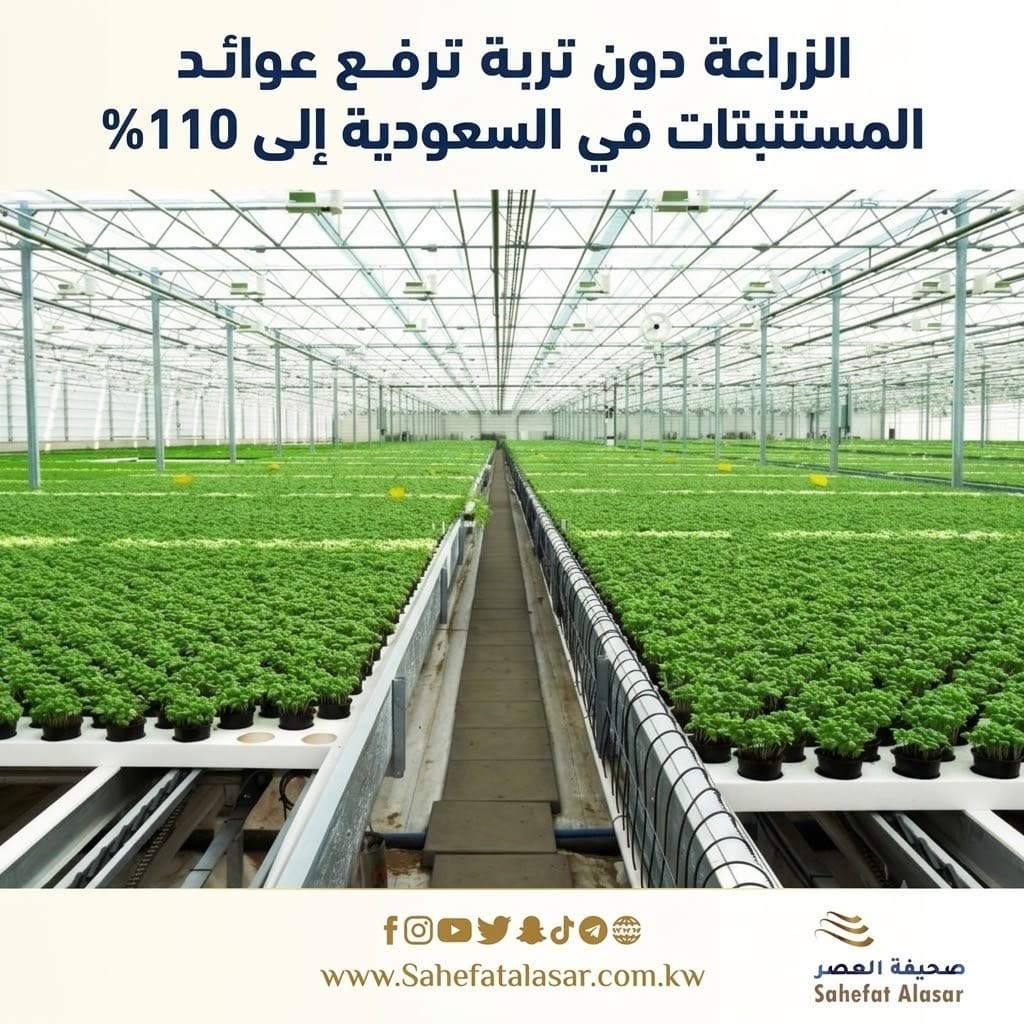
Saudi Arabia is expanding its use of soilless farming technologies to address water scarcity and increase agricultural production. This coincides with the integration of artificial intelligence and the Internet of Things in crop management and needs assessment, contributing to a reduction in reliance on labor and traditional agricultural land.
These technologies allow for a 97% reduction in water consumption compared to open fields, while the return on investment in traditional crops ranges between 30% and 38%, reaching up to 110% in greenhouses.
The founder and chairman of Erama Company, Engineer Abdullah Sahab, told Al-Eqtisadiah that an investor can recoup their capital within one year when using the technology in greenhouses, while the payback period takes between two and a half to three and a half years when using it for growing salad and cooking vegetables.
The cost of establishing one square meter of these farms ranges between 5,000 and 9,000 riyals, including construction, air conditioning, and the technological system, depending on the project's size, location, and the type of systems used.
The operating cost of protected farms reaches about one-tenth of the production cost in open fields. The cost of producing a ton of a crop can decrease from 1,000 riyals in traditional agriculture to about 100 riyals using the technology, with the cost varying according to the type of crop and the system used.
Productivity increases up to 80 times.
Sahab explained that hydroponics is the common name for soilless farming, which relies on alternatives such as rockwool, volcanic wool, and other media, and is used to produce salad and cooking vegetables, as well as some types of fruits and crops related to daily consumption.
The need for these technologies is growing in the Saudi market due to water scarcity and the declining number of people working in agriculture. Automation and mechanical systems allow a young man or woman to manage the equivalent of five or six farms simultaneously.
Modern systems can increase the productivity of agricultural land by 8 to 80 times that of open fields, depending on the technology, crop, and plant distribution method, with the possibility of producing across multiple seasons within a limited area.
Water consumption is reduced;
soilless farming uses only 3 to 5% of the water used in open fields, thanks to water reuse and reintroduction into the irrigation cycle, resulting in savings of up to 97%.
Sahab stated that the absence of control and automation systems in some open fields leads to excessive water consumption, and over-irrigation can cause root rot and reduced crop quality.
According to the UN Food and Agriculture Organization (FAO) 2025 report, Saudi Arabia is among the three most water-scarce countries in the world, consuming 987% of its renewable water resources.
The agricultural sector accounts for more than 84% of water consumption, compared to about 12% for the residential sector and 4% for the commercial and industrial sectors. Local production covers approximately 7% of food needs, according to figures cited by Sahab.
Reducing water consumption is one of the main drivers of investment in modern agriculture, along with increasing production, reducing land use, decreasing labor requirements, and improving crop quality.
The AI-powered farm management system,
developed by the company "Erama," tested approximately 128 crops using soilless farming techniques. These included lettuce, arugula, coriander, parsley, tomatoes, strawberries, cucurbits, some types of cherries, and fruit trees.
Salad and cooking vegetables showed the highest return on investment among the tested crops, driven by high demand and the possibility of continuous production.
A single farm allows for the production of multiple crops, including lettuce, coriander, arugula, parsley, tomatoes, and strawberries, with the ability to isolate each shelf and control its feeding, lighting, and temperature independently.
According to Sahab, tailoring the environment to each crop allows for diversification of production within a single square meter, unlike open fields which are affected by climate, irrigation methods, and available space.
One square meter in one system produces approximately 25 kilograms per month, while vertical farms allow for maximizing height and multiplying the number of plants in the same area.