صحافة الكترونية مرخصة وزارة الاعلام ترخيص رقم 366-2019

صحافة الكترونية مرخصة وزارة الاعلام ترخيص رقم 366-2019
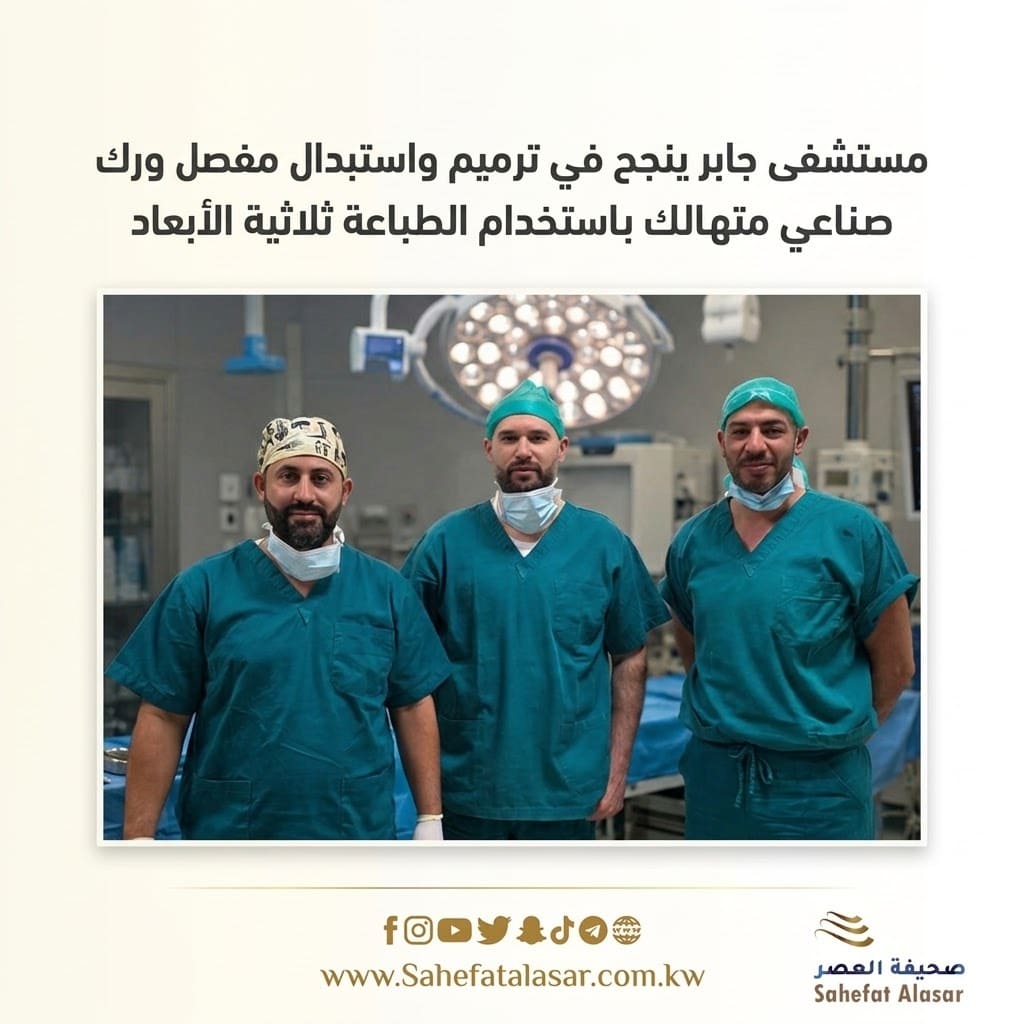
In a new medical achievement that reflects the continuous development in orthopedic and joint surgeries and the use of modern technologies in surgical planning, a medical team at Jaber Hospital, headed by the head of the orthopedic surgery department, Dr. Hashem Al-Ali, succeeded in performing a qualitative and complex operation to repair and replace the (artificial) hip joint of a 48-year-old patient, using 3D printing technology in the precise and pre-planning of the operation.
This operation is the first of its kind at Jaber Hospital using Cup-Cage Construct technology, as the patient was suffering from previous hip joint failure, complications resulting from metallosis, in addition to significant loss of pelvic bone, which necessitated advanced surgical planning appropriate to the nature and complexity of the case.
The medical team used CT scans and 3D printing technology to produce a model that matched the patient's pelvis before the operation. This allowed for a precise study of areas of bone loss and bone defects, and the determination of the most appropriate surgical approach before the actual intervention began.
Based on prior planning, the team performed an advanced reconstructive procedure that included bone grafting and the use of Cup-Cage Construct technology, which aims to achieve the necessary stability for the joint and support long-term bone fusion.
The operation was a success, as the patient was able to stand, move and started walking on the second day after the operation, a positive indicator of early recovery after surgical intervention.
This achievement embodies the importance of employing modern technologies, especially 3D printing, in the advance planning of complex surgeries, giving medical teams a more accurate view of anatomical challenges and contributing to enhancing the accuracy of surgical interventions and improving treatment outcomes.
The achievement also reflects the expansion of health services in the State of Kuwait in localizing advanced medical technologies and expertise, and building the capabilities of national cadres to deal with complex cases and provide specialized care within the country according to the latest medical practices.